
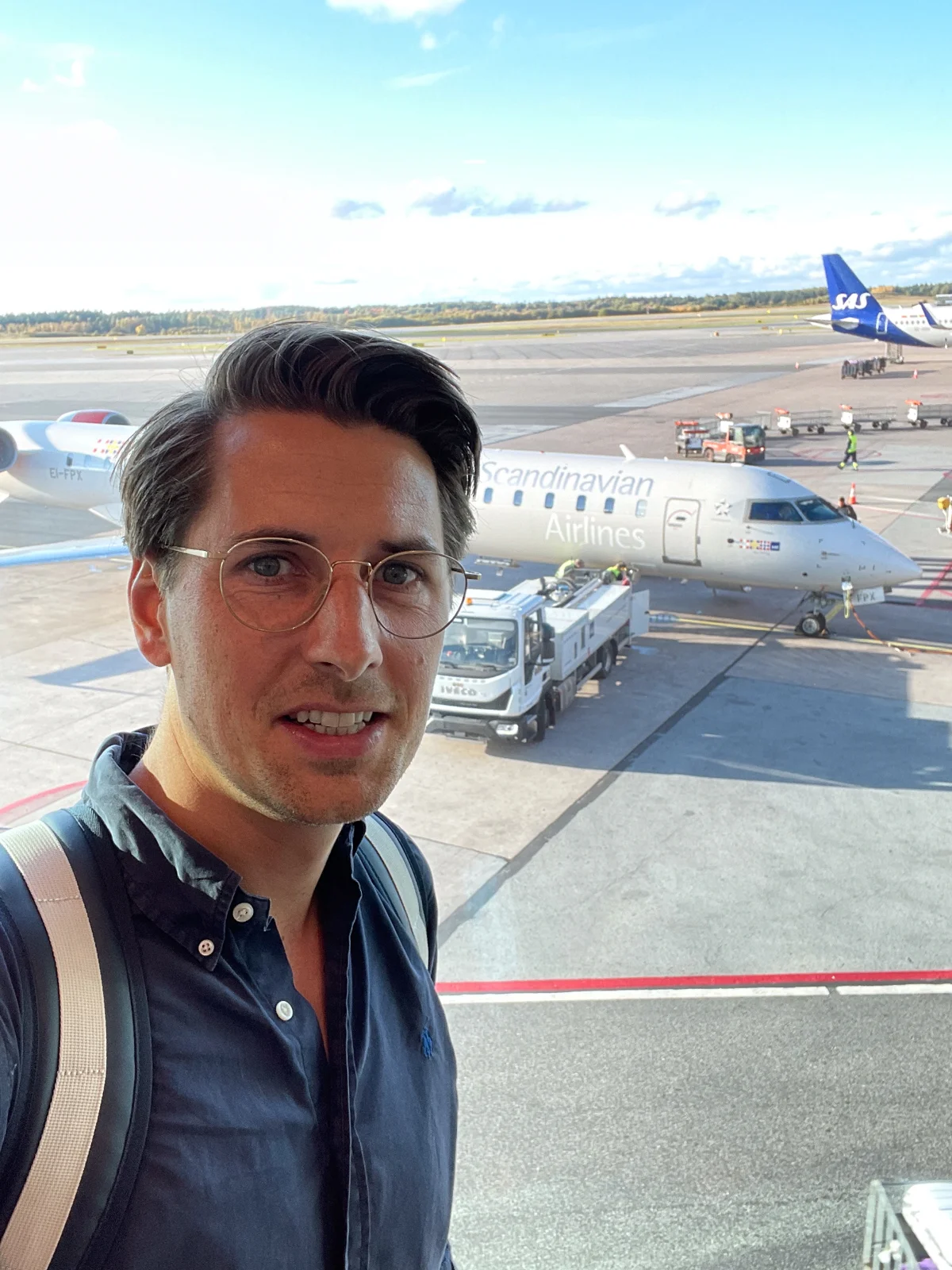
In 2012, Nico’s phone rang in his apartment in Hamburg. It was Emma, his long-distance girlfriend, calling from an airport in Switzerland. A snowstorm had grounded the airport, and her flight to see him for Valentine’s Day and his birthday had just been cancelled. She was upset, and the airline had nothing left to offer her: no rebooking, no alternative, no plan.
Nico refused to accept that. He was a seasoned traveler, and he knew there was more than one way to get across Europe. After a few minutes of searching, he found an overnight train that left in an hour. Emma grabbed her bags and ran to the station. The next morning, he picked her up, their weekend saved.
For fourteen years, he turned that experience over in his mind. Most people would have let it go but Nico couldn’t. Why wasn’t there a travel platform that monitored your trip in real time and offered backup plans automatically if something went wrong?
 AVARA
AVARA"If there’s a delay or cancellation, airlines only look at their flight options. Trains only look at the train system. There’s no one looking broadly at all the possible solutions."
Nico believed in the idea enough to pitch it to his colleagues at Google. With no engineering background, he knew it was a stretch walking into a room full of engineers with a product idea but he needed to know what they thought. “I wasn’t laughed out of the room, but they made it pretty clear to me that without a huge funding round and 50 engineers, it wasn’t possible,” he says. “All the flight data and real-time updates created a massive amount of complexity I hadn’t considered.”
So, Nico set the idea aside, built his sales and marketing career and filed the idea away, doubtful he’d ever act on it. Maybe it just wasn’t meant to be.


An old dream resurrected by AI
When Nico saw AI start to reshape his job, his first instinct was to become an expert. “I saw the writing on the wall pretty early. I could either be the one driving this revolution, or be left behind.” He took courses to learn as much as he could and eventually became SAP’s AI lead. But the more he learned, the more he realized AI wasn’t just changing how work got done — it was changing who could do what. All the reasons that had stopped him from building his long-held idea no longer held up. There were tools now that could do the part that had stopped him in 2012. He couldn’t stay in his corporate job wondering, what if? So he quit.
Nico jumped in with conviction, then immediately doubted himself. His first vibe-coding platform generated code he couldn’t read, couldn’t preview, and had no way of testing.
A friend recommended Lovable. The experience was different. “You see the results so quickly. You can’t really stop once you see your vision coming to life,” says Nico. He consulted Lovable on everything: the business plan, the UI, the UX. What surprised Nico was how much fun he was having: “It felt like a passion project rather than work.” For months he stayed up late every night working with Lovable after he and his now-wife, Emma put their two young kids to bed. “I was probably less social last year than usual,” Nico says with a laugh. “But I also got way more done than I ever thought possible.”
A full-stack travel platform, without the full-stack engineers
His ambition quickly outgrew his original idea. “Most travel tools treat you like a transaction,” he says. “They wait for you to do the work: search, compare, book, repeat, then forget you the moment it’s done. I wanted to build the opposite. Something that pays attention to who you are, and acts before you have to ask.”
Nearly a million lines of code later, AVARA is now a full-stack travel platform with:
- Real-time bookings: Unlike airlines that only look for flights, AVARA searches everything—flights, trains, buses, ferries, rental cars, and more, all from one place. Flight, hotels and package bookings will be live at launch, with the rest of the network rolling out shortly after. Users can book and pay for their trip natively in the app.
- Proactive trip monitoring: In the background, the AI concierge scans your itinerary in real time and alerts you before problems become crises. If Emma had AVARA back in 2012, it would have notified her the moment her flight was cancelled and shown her the available alternatives, including the overnight train, ready to book within minutes. “The promise of AVARA is that we never leave you behind,” Nico says. “We always show you the way home.”
- Emergency response readiness: If you’re stranded somewhere unfamiliar, AVARA alerts your emergency contacts to confirm you’re safe and shows you options for hospitals, embassies, and more via global navigation with Mapbox.
- 85+ crowdsourced city guides and counting: AVARA has already built and published more than 85 destination guides, ready to explore from day one. Users can also upload their own travel notes in just about any file format, and AVARA converts them into a sharable city guide that credits the creator.
- Group travel planning: A built-in messaging function, complete with read receipts and offline support, lets groups coordinate an entire trip without leaving the app. Share itineraries, consolidate bookings, and split expenses, all in one place, with no need to jump over to WhatsApp or Telegram.
“I’m most proud of the group messaging feature,” says Nico. “I essentially built my own WhatsApp messaging app in Lovable. The night I got it to work, I woke Emma up at 2am to make her test it with me. I couldn’t believe I was capable of building something so complex.”
When Nico reflects back on what he’s built over the last year, he realizes his old Google colleagues weren’t exaggerating. The complexity of the problem hadn’t gone away with time. What changed was his ability to build it.
“I had to build dozens of integrations to booking systems like Amadeus and backend services like Stripe and Lovable Cloud. What changed was the tools. I finally had the ability to build this myself. I always had the conviction and the willingness to spend the time but now I had the means to do it.”
All of this happened in less than a year, which Nico still finds hard to believe. He estimates Lovable saved him roughly 125,000 hours of coding, the equivalent of 14 years of nonstop work and — ironically — exactly how long he carried the idea before building it. “I can comfortably say I can build just about any product on the market with Lovable. If I see a product I admire and want to add that functionality in AVARA, I just need to give myself a bit of time but I know I can build it. A couple of years ago, that would have been impossible to imagine.”
AVARA is ready for takeoff
After four months in closed beta with users in 17 countries, Nico is preparing to launch AVARA publicly in Europe and raise his first round of funding, all as a solo founder. The hardest part of the past year wasn’t writing the code, he says. It was learning the rules: travel regulation, licensing, consumer protection law, the parts of the industry that have nothing to do with software and everything to do with operating responsibly across dozens of countries at once.

“You see the results so quickly. You can’t really stop once you see your vision coming to life.”
AVARANico is candid about the size of the ambition. “I believe AVARA can become the world’s most trusted platform for travel and human connection,” he says. “Not the loudest one. The one people return to. The one they rely on, for the everyday planning and for when plans change.”
Nico’s advice for others sitting on an idea? “Just start,” he says. “The opportunity cost of failing is so, so low. You’ll learn fast what works and what doesn’t. Use that feedback and course correct. Even if you have a full-time job, you can try it as a hobby. Delete Instagram and use that time to build. There’s no need to be afraid anymore.”

 QuickTables
 Saath
Saath
 WeGlow
 Klar
Klar
 WNTD
WNTD